
Construction
Where Construction Debris Actually Goes Around New Britain
Curbside is built for five household items a visit. A renovation is a different category of problem, and here is where the material actually goes.
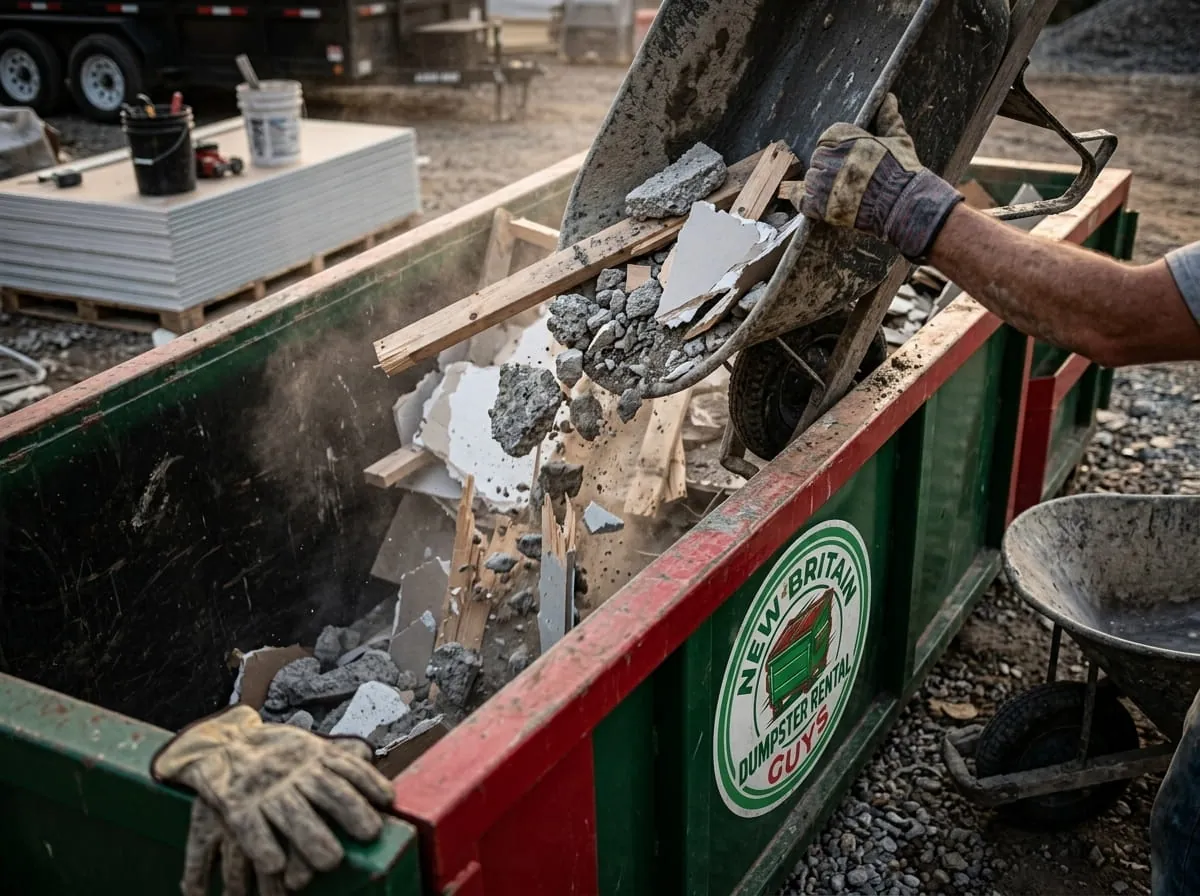
Where curbside stops
Every market has a line where municipal collection stops and a container starts. Here the line is drawn by design rather than by exclusion — the City programme is built around household items, and a renovation is simply not what it is for.
City bulk pickup takes five items per unit per pick-up, by appointment, booked through the hauler, for buildings up to six families. A bathroom gut produces a tub, a vanity, a toilet, tile, plaster and flooring across a fortnight. That is not five items and it is not household waste.
The non-burnable cap in practice
The restriction that shapes renovation planning here, and it is easy to trip over.
Non-burnable collections are limited to one per fiscal year. Non-burnable is the heavy inert and metallic end — masonry, concrete, porcelain fixtures, appliances, metal. Exactly what demolition produces.
Two practical consequences:
- Sequence matters. If you use the annual non-burnable collection on a spring porch slab, it is gone when the autumn bathroom comes out.
- Mixing costs you. A pile that is mostly furniture with one old cast iron sink in it can pull the whole booking into the non-burnable category.
For a project of any size the calculation resolves quickly: keep the annual collection for a genuine small one-off, and put the project in a container.
Donate the usable material first
This is the step most people skip, and in New Britain specifically it is worth real money.
There is a non-profit building materials reuse centre in the city that accepts usable materials in good condition — cabinets, doors, windows, fixtures, timber, hardware — resells them, and issues a receipt for a tax deductible donation.
On a kitchen this changes the arithmetic twice over. Cabinets removed intact are a donation and a deduction. The same cabinets smashed out with a sledgehammer are tonnage you pay to haul. The only cost is taking them out carefully, which is often no slower.
The same applies to solid doors, decent windows, sound dimensional timber, light fixtures and unbroken sanitaryware. More on how that works here.
Why stream separation saves money
Disposal is priced per ton and the rate varies by stream. Mixed C&D is the most expensive. Clean inert material — concrete, brick, stone — is cheaper. Scrap metal has positive value.
Consider a renovation producing six tons of plaster and general debris, three tons of clean masonry from a chimney breast, and a pile of copper pipe, ductwork and cast iron. All in one container and you pay the mixed rate on everything. Split it and the masonry moves to a cheaper route while the metal earns rather than costs.
The five streams worth separating
1. Usable building materials
Donation, not disposal. First on the list because it is the only one that costs nothing and gives something back.
2. Clean concrete, block, brick and stone
Rebar is generally fine. Timber, plastic sheeting and general debris are not. Goes in a 10 yard because of weight, always.
3. Scrap metal
Copper pipe, steel studs, ductwork, conduit, railings, radiators and cast iron. Older housing here is full of it, and it has positive value.
4. Clean dimensional lumber
Untreated, unpainted, fasteners removed where practical. Treated timber does not qualify, which matters because deck and fence timber nearly always is.
5. Cardboard and packaging
New construction generates an extraordinary amount and it does not belong in your paid tonnage.
Plaster and lath change the maths
Worth its own section because it is the most common sizing error on older-house work here, and this region has a great deal of older housing.
Pre-1940 building across New Britain, Bristol, Meriden, Hartford and the older village centres is plaster on wood lath, not drywall. Plaster is dramatically heavier — a room that would be a comfortable half-container of drywall debris can be at its weight allowance in plaster alone.
The genuinely old property adds more: oak and chestnut framing, stone foundations, and in the grander houses slate roofing. All far denser than modern equivalents. Wethersfield, Farmington and Simsbury have plenty of it.
The practical consequence: on an older-house gut, size down and swap more often rather than filling one big container you cannot legally haul.
Asbestos and pre-1980 buildings
This region has a very high proportion of pre-1980 housing and genuinely old industrial fabric — this was a manufacturing city. Floor tile and its mastic, pipe lagging on old steam and boiler runs, and textured coatings are the usual culprits.
Anything from before roughly 1980 should be treated as asbestos-suspect until surveyed. Abatement is licensed work with its own disposal route and it never goes in a roll-off container. Get the survey done before demolition starts rather than halfway through a strip-out.
Practical site setup on a tight lot
- Place containers where the work is, not where they are convenient for the truck. Labour spent walking debris across a site is the largest hidden cost in waste handling.
- On a tight city lot, plan the swap sequence first. If there is only one workable placement you cannot have two containers at once, so the job has to be phased around swaps rather than run in parallel. Tell us the programme and we will schedule it.
- Stage the donation pile indoors if you can. Materials left out in the weather stop being donatable quickly.
- Check the overhead before the trades arrive. Twenty-two feet of clear height is what the truck needs, and on tree-lined streets that is the binding constraint.
- Label the containers. A sheet of plywood marked CLEAN MASONRY ONLY protects the cheaper route.
- Keep spills off the pavement. The City is explicit that storm drains empty into waterways — no oil, chemicals or paint washings anywhere near a gutter.
- Cover it in winter. A frozen load will not tip and the container comes back still full.
- Watch the spring thaw. When the frost comes out, a site route that carried loaded trucks all winter will not carry them in April.
We are happy to help set that up — tell us the build programme and we will schedule around the trade sequence.
Need a container in New Britain?
Call and describe the job. Three minutes on the phone gets you a size recommendation, a flat rate and a delivery window — and we will tell you if a smaller, cheaper container is the right answer.
Call (860) 893-0282