
Practical
Protecting Your Driveway, and Getting Through Winter
A loaded roll-off puts several tons on four small steel contact points. Then winter arrives and changes where it can safely sit at all.
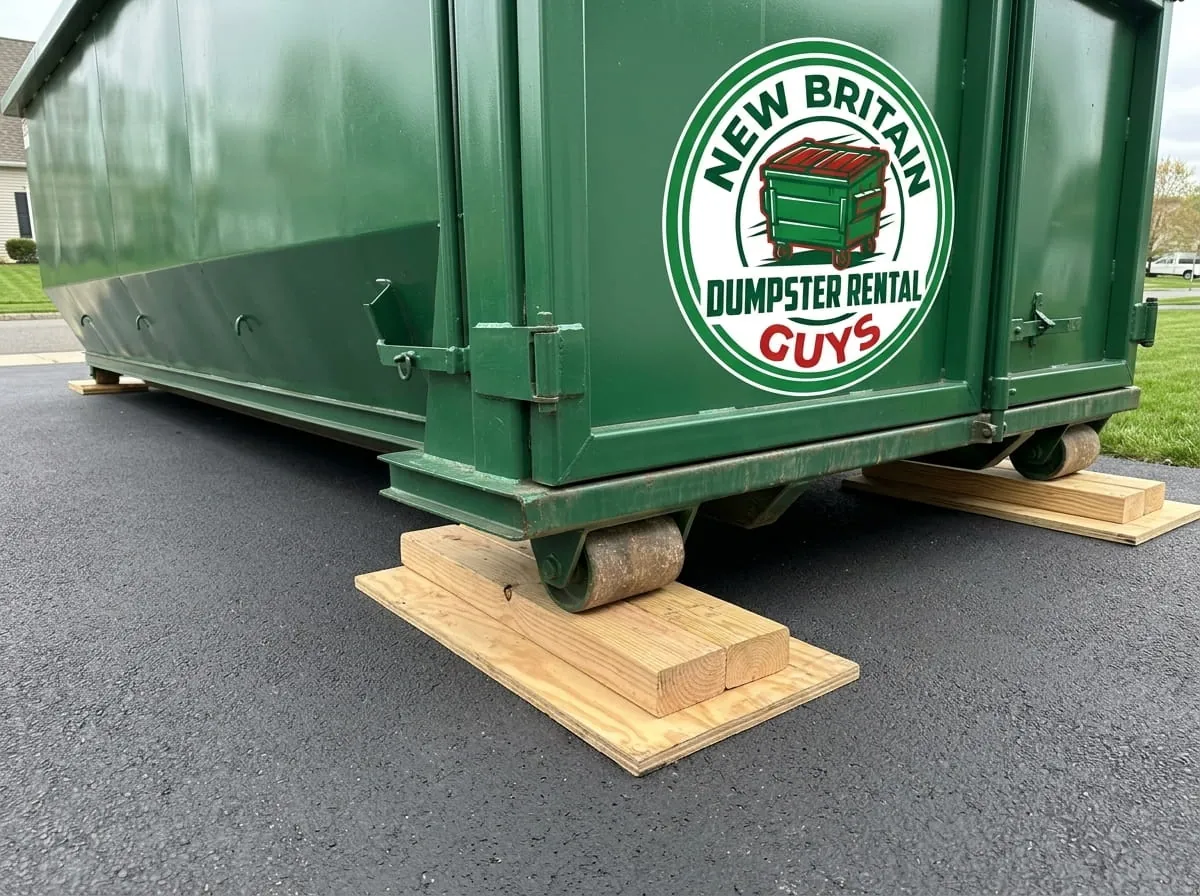
How the damage actually happens
People picture the container's weight spread across its footprint. It is not. A roll-off sits on two steel rails and concentrates load at a small number of contact points — typically the rear wheels and the front of the rails.
A 20 yard loaded to four tons, plus the container's own weight, puts something in the order of several thousand pounds onto each of those points. Three mechanisms follow:
- Static load. The container sitting there over days, gradually pressing in.
- Dynamic load during delivery. The moment the container rolls off and the rear wheels touch down is the highest instantaneous load of the whole rental.
- Dragging. Winching the container back on drags the rails across the surface.
What protection boards do
Timber or plywood under the rails spreads a point load across a much larger area. It is unglamorous and extremely effective — the difference between several thousand pounds on four small contacts and the same weight distributed across several square feet.
Our drivers carry boards on every truck as standard equipment. They go down before the container touches the surface, not afterwards, and again on collection because the drag-on is as damaging as the drop-off. On pavers and decorative concrete we double up.
Frost heave and what it leaves behind
Frost goes deep in central Connecticut. Water in the ground freezes, expands, lifts the slab or the asphalt above it, and then in spring the frost comes out and everything settles back — but not evenly, and not always into the same shape.
Do that every winter for forty or fifty years, which is the age of a great many driveways here, and you get the cracked, heaved and hollow-underneath surfaces that are entirely normal in this region. A driveway that looks sound in September may have a void under it that only appears when a point load finds it.
The tell is a section that rocks slightly underfoot, or a slab edge with a visible step. If you have either, point it out and we will place away from it.
The spring thaw is the risky season
If there is one thing to take from this page, it is this.
Frozen ground is genuinely strong. A placement that works perfectly in January can be the worst possible idea in early April. Out in Burlington and Plymouth, where the hills hold frost later, that window runs later still.
That is why we ask about timing on gravel drives and unpaved access, and why we may suggest waiting a fortnight or placing at the road end instead.
Surface by surface
Concrete driveway
Generally fine with boards down. Watch for frost cracking, lifted edges and any section that sounds hollow underfoot. A slab already cracked will preferentially fail along that line.
Asphalt
Very common here and vulnerable at both ends of the year. It softens in July heat and becomes brittle in deep cold. Boards are essential either way.
Pavers and decorative concrete
Doubled boards as standard, and we lift rather than drag where possible. The pavers themselves are strong; it is the sand bedding underneath that displaces.
Gravel
Common on the rural property out toward Burlington and Plymouth. Forgiving in dry or frozen conditions. Poor during the thaw, because there is nothing spreading the load once the base softens.
Grass and bare ground
Fine when frozen hard or dry and firm. Never during the thaw.
Yes, we deliver all winter
People ask, so: yes, we run all year, and winter is one of our busiest stretches. When it is dark at five, people finish cellars, gut bathrooms, clear out garages and empty houses. Interior work is winter work here.
What changes is the setup, not whether we come. Almost every winter problem we see is avoidable with a five-minute conversation at booking — and the good news, per the section above, is that frozen ground is on your side.
The frozen load, and the plow
The frozen load is the most common winter problem and completely preventable. If wet material goes into a container and then freezes, it bonds to the walls and floor. When the truck lifts the container, the load does not slide out — it sits there, and the container comes back to the yard still full.
- Cover the container. A tarp through a storm is the whole solution.
- Do not shovel snow into it. It is heavy, you pay for it by weight, and it is the main source of the water that freezes the load.
- Avoid loading soaked material on top of a hard freeze, or get it collected before the next cold snap.
- Do not let it sit part-filled for weeks in January. Shorter rentals work better in deep winter.
The plow is the other winter consideration. Think about where the snow is going to be pushed. A container placed at the top of a driveway on a clear December day can be behind a four-foot bank by mid-January. On the narrow city streets this is worse than usual, because there is nowhere for the snow to go except against the kerb.
The good placement is usually further down the drive than people expect, on the side away from the plow throw. And keep the approach shovelled for collection day — a truck that cannot back in is a wasted movement, and we would rather reschedule than charge you a dry run.
If something does go wrong
It is uncommon, but it happens. Tell us straight away rather than after the container is gone. Photograph it. We are licensed and insured, and where damage results from our placement we deal with it rather than arguing about it.
What we cannot take responsibility for is damage from a hazard nobody told us about — a sprinkler line or septic field we did not know was there, or a driveway already failed by frost that we were not shown.
The short version
- Boards go under the rails on every delivery. If a hauler does not do this as standard, use a different hauler.
- Tell us about frost cracking, lifted edges and anything that rocks underfoot.
- Be flexible about timing in the spring thaw — that is the risky season, not winter.
- Cover the container through winter storms, and never shovel snow into it.
- Think about where the plow throws the snow before choosing the spot.
- Photograph existing damage before delivery.
Need a container in New Britain?
Call and describe the job. Three minutes on the phone gets you a size recommendation, a flat rate and a delivery window — and we will tell you if a smaller, cheaper container is the right answer.
Call (860) 893-0282