Rules
What Can and Cannot Go in a Dumpster: The New Britain List
The accepted list is long and boring. The prohibited list is short, strictly enforced, and the reason loads occasionally get turned away. Here is both.
The short version
If it came out of a building, a yard or a household and it is solid, non-hazardous and not on fire, it can almost certainly go in the container. If it is liquid, toxic, pressurised, or contains asbestos or refrigerant, it cannot.
That covers about ninety-five percent of questions. The rest of this article is the other five percent, which is where the money and the headaches live.
What you can put in
Household and furniture
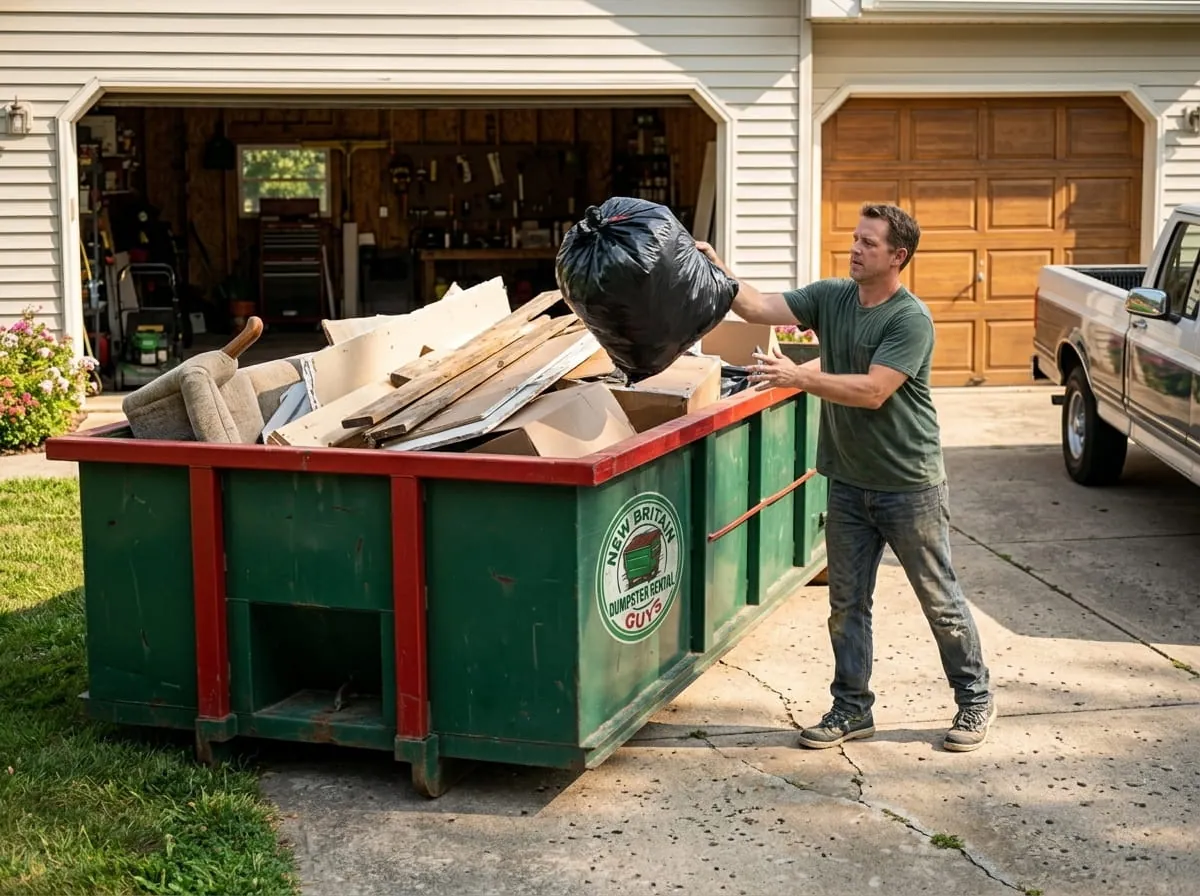
Sofas, armchairs, beds, mattresses and box springs, tables, wardrobes, bookcases, desks, carpets, rugs, curtains, clothing, linens, toys, books, paperwork, kitchenware, patio furniture, grills with the propane tank removed, exercise equipment and general clutter. No mattress surcharge on our containers.
Worth setting against the City allowance: all of that together is well past the five items a bulk booking takes.
Construction and renovation debris
Drywall, plaster and lath, timber, plywood and sheet goods, doors, windows, trim, kitchen cabinets, countertops, tiling, laminate and vinyl flooring, insulation, siding, soffit and fascia, guttering, fencing and deck timber, and general non-hazardous building material.
Cellar and interior strip-outs
Panelling, suspended ceiling tile and grid, carpet and underlay, framing, drywall and old built-in furniture. Mostly bulky rather than heavy — unless it has been wet, which in a Connecticut cellar it often has.
Roofing
Asphalt shingle in both three-tab and architectural, metal panels, felt and synthetic underlayment, flashing, drip edge and roof decking. Weight is the constraint, not acceptability.
Heavy and inert material
Concrete, block, brick, pavers, stone, rubble and tile. All fine, all heavy — these belong in a 10 yard.
Scrap metal
Ductwork, conduit, steel studs, railings, fencing and appliances without refrigerant. Worth separating, because it has positive value.
What is prohibited
- Liquids of any kind — paint, stains, varnish, thinners, solvents, oils and fuels
- Asbestos-containing material — common in pre-1980 floor tile, mastic and pipe lagging, and very common in housing of this age. Licensed abatement only
- Tyres
- Batteries of any kind
- Propane, gas and pressurised cylinders, including "empty" ones
- Refrigerant-charged equipment that has not been professionally evacuated
- Pesticides, herbicides and fertiliser
- Medical and infectious waste, including sharps
- Hot ashes or anything smouldering
- Contaminated soil
- Fluorescent tubes and older ballasts
Burnable and non-burnable is the local distinction
Most markets sort waste into household, bulky and construction. Around here there is an extra split that shapes what the City will collect, and it is worth understanding.
Broadly, burnable is the combustible household end: upholstered furniture, mattresses, carpet, wood furniture. Non-burnable is the heavy inert and metallic end: masonry, concrete, porcelain fixtures, appliances, metal.
Two consequences follow. First, a mixed pile can pull your whole booking into the non-burnable category — and that is the once-a-year one. Second, if you have a genuine non-burnable job coming later in the year, spending the allowance early is a real cost.
Nothing about that distinction limits what we can take. It matters for planning which route to use.
Donate it before you dump it
Worth its own section because New Britain has something most markets do not, and it is free.
There is a non-profit building materials reuse centre right here in the city. It takes usable materials in good condition — cabinets, doors, windows, fixtures, timber, hardware — resells them, and the donation is tax deductible.
On a kitchen or bathroom renovation this genuinely changes the arithmetic. Cabinets and a countertop coming out in one piece are a donation; the same cabinets broken up with a sledgehammer are tonnage you pay to haul. It costs you the care of removing them intact and nothing else. More on how that works here.
The grey areas people ask about
Paint cans
Liquid paint is prohibited. Dried-out latex paint is generally acceptable — open the can and let it harden with cat litter or sand. Oil-based paint is hazardous wet or dry and goes to a regional household hazardous waste collection.
The City is specific about the related point: do not wash out paint brushes, pans or rollers in the gutter, and do not let paint spills accumulate on a driveway or sidewalk. Storm drains empty into waterways.
Fireplace and wood ash
Only when completely cold — days, not hours. Embers stay live far longer than people expect.
Treated timber
Acceptable in a mixed load, not in a clean-wood container. Deck and fence timber is nearly always treated.
Appliances with a compressor
Fridges, freezers and window air conditioning units need the refrigerant professionally evacuated first.
Anything from a contractor
Straightforward: it is theirs to remove. Contractor-generated debris is not a residential curbside item anywhere in this region.
Where the rest has to go
| Material | Where it goes |
|---|---|
| Usable cabinets, doors, fixtures, timber | The non-profit reuse centre in New Britain - free and tax deductible |
| Oil-based paint, solvents, chemicals | Regional household hazardous waste collection events |
| Latex paint | Dry it out, lid off, then regular refuse |
| Motor oil, antifreeze | Never down a storm drain - they empty into waterways |
| Tyres and vehicle batteries | Retailer take-back |
| Fridges, freezers, window AC units | Professional refrigerant evacuation first |
| Broken municipal trash or recycling cart | Replacement by application, with a per-cart fee |
| Asbestos | Licensed abatement contractor only |
A pre-load checklist
- Walk the pile and pull out anything liquid, pressurised or chemical
- Set aside anything usable — cabinets, doors, fixtures, good timber — for the reuse centre before you start breaking things up
- Check the garage and cellar for propane cylinders, old fuel cans and paint
- Check any appliance with a compressor for refrigerant
- Make sure any ash is stone cold
- If the building predates 1980 and you are disturbing floor tile, mastic or pipe lagging, stop and get it tested
- Pull out the scrap metal — it has value
- Load flat and heavy first, bulky on top, and stop at the rail
Need a container in New Britain?
Call and describe the job. Three minutes on the phone gets you a size recommendation, a flat rate and a delivery window — and we will tell you if a smaller, cheaper container is the right answer.
Call (860) 893-0282