
Sizing
What Size Dumpster Do I Need? An Honest New Britain Guide
Most sizing guides lead with cubic yards. That is the least useful number, because almost nobody can estimate their own debris in cubic yards. Here is how we actually do it on the phone.
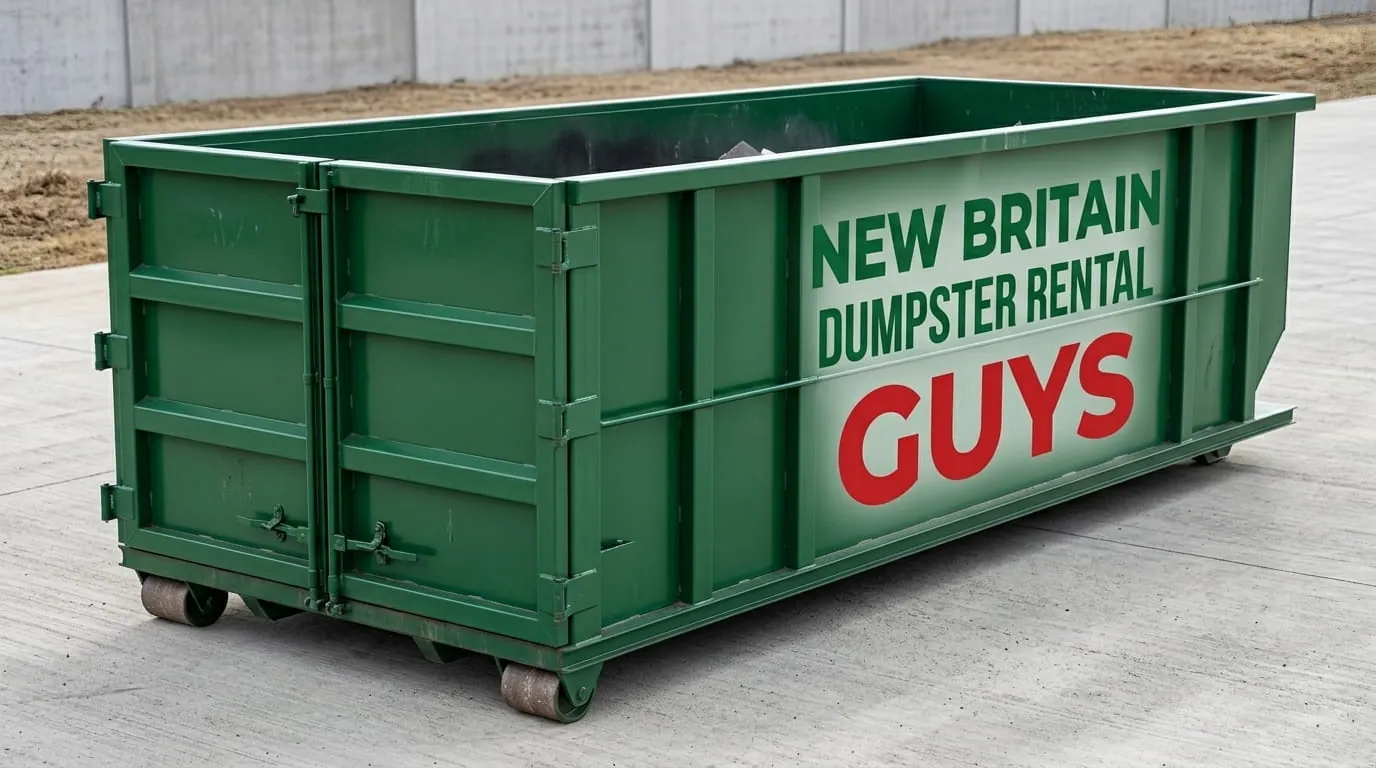
Why cubic yards is the wrong question
Every dumpster sizing guide opens the same way: a 10 yard holds ten cubic yards, a 20 yard holds twenty. True, and almost completely useless, because nobody standing in their cellar looking at forty years of accumulated stuff can convert that into cubic yards.
What we actually ask on the phone is three questions. What are you throwing away? How much of it, in terms you can picture — pickup loads, rooms, squares of roof? And where is it going to sit? Those three answers get us to the right container about ninety-five percent of the time, and everything after that is about weight.
The two constraints: volume and weight
Every container has two limits and you will hit one of them first. Volume is the obvious one: the box is only so big and you cannot legally load above the top rail. Weight is the one people forget, and it is the one that costs money.
Each size comes with an included tonnage. A 10 yard typically includes one to two tons, a 30 yard four to five. Go over and you pay a per-ton overage rate, which we quote before you book.
What each size really holds
10 yard — 12 ft × 8 ft × 3.5 ft
Three to four pickup loads. One to two tons included. The small-job container and, more importantly, the heavy material container. A bathroom gut. A walkway slab. Broken concrete, brick and plaster. Low three-and-a-half-foot sides mean you can throw material over the wall without a ramp — which matters on a tight lot where you may be loading from a narrow side yard.
15 yard — 16 ft × 8 ft × 4 ft
Five to six pickup loads. Two to three tons. The most under-used size in the industry and the one we place most often in this market. New Britain, Bristol, Meriden, Hartford and the older village centres were built on short single-width drives, and a 15 yard is sixteen feet against a 20 yard's twenty-two.
20 yard — 22 ft × 8 ft × 4.5 ft
Seven to eight pickup loads. Three to four tons. The standard container in the newer suburbs — Newington, Rocky Hill, Avon, Southington's subdivisions — where driveways are generous.
30 yard — 22 ft × 8 ft × 6 ft
Ten to twelve pickup loads. Four to five tons. Same footprint as the 20 with eighteen more inches of height, so it holds half again as much without needing any more driveway. The builder's container, and the right call for a barn or outbuilding out toward Burlington or Southington.
Worked examples from real central Connecticut jobs
| Job | Size | Why |
|---|---|---|
| Bathroom gut, plaster and tile | 10 yard | Small volume, but plaster and cast iron are heavy |
| Walkway or porch slab removal | 10 yard | Concrete is roughly 2 tons per cubic yard |
| Stone wall or old foundation | 10 yard | Stone is the densest thing we haul |
| Two-car garage clear-out | 10-15 yard | Bulky, light, easy to load |
| Older city lot, short drive | 15 yard | Length is the limit, not volume |
| Kitchen renovation, mid-size | 15-20 yard | Cabinetry eats volume; a tile floor pushes weight up |
| Finished basement strip-out | 20 yard | Panelling, carpet and framing: big volume, low weight |
| Shingle re-roof, 26 squares | 20 yard | Around 4 tons of shingle - at the allowance limit |
| Two-family turnover, both units | 20-30 yard | Furniture and mattresses eat volume fast |
| Barn or outbuilding demolition | 30 yard | Timber and metal roofing: huge volume, low weight |
The weight traps in Hardware City housing
Plaster and lath
The big one here. Pre-1940 housing across New Britain, Bristol, Meriden, Hartford and the older village centres is plaster on wood lath, not drywall, and plaster is dramatically heavier. A room that would be a comfortable half-container of drywall is at its weight allowance in plaster.
Old-growth framing and stone
The genuinely old property — and Wethersfield, Farmington and Simsbury have plenty going back to the eighteenth century — is oak and chestnut framing on stone foundations. Both are far denser than anything milled or poured today.
Concrete, brick and masonry
Roughly 4,000 pounds per cubic yard. A single cubic yard of broken slab weighs about as much as a small car.
Anything from a cellar that has taken water
Full cellars are standard in this region and spring water is common. Saturated carpet, panelling, drywall and framing weigh a multiple of their dry equivalent. Say so when you book and we size for weight.
Snow in an open container
A Connecticut winter puts real weight into an open container, and once it compacts and refreezes you pay to haul it. Keep it covered. More on winter here.
Multi-family changes the answer
Worth its own section, because New Britain has a much higher proportion of two-family and three-family housing than the suburbs around it, and it changes sizing in both directions at once.
Contents size up. Clearing two or three units at a turnover produces furniture, mattresses, carpet and household goods — bulky and light. That fills volume fast without troubling the weight allowance, so a 30 yard often makes sense where the floor area alone would suggest less.
The building sizes down. If you are renovating rather than clearing — taking out plaster, lath, old flooring and cast iron — the material is dense and the container has to be smaller.
On a job that does both, that is a strong argument for two containers rather than one, and it is worth saying which phase you are in when you call.
One more practical point: the City's own bulk pickup programme is limited to buildings of six families maximum. Anything larger has no residential curbside route at all.
Two smaller containers vs one big one
On larger jobs this is frequently the cheaper route, and almost nobody asks about it.
Disposal is priced by stream. Mixed construction and demolition debris costs the most per ton. Clean inert material — concrete, brick, stone — is cheaper. Scrap metal has positive value.
And there is a step before any of that which is free: usable building materials can be donated rather than dumped. There is a non-profit reuse centre right here in New Britain that takes cabinets, doors, fixtures and timber in good condition, and the donation is tax deductible. More on that here.
How to describe your job on the phone
- What the material is. "Kitchen cabinets, countertop, appliances and about 200 square feet of tile floor" tells us everything.
- Whether it is plaster or drywall. It genuinely changes the container.
- Roughly when the house was built. Pre-1940 material is much denser.
- Whether it is single or multi-family, and whether you are clearing or renovating.
- Whether the cellar has ever taken water. It changes the weight answer.
- Your driveway width, and the time of year if access is unpaved.
That is a ninety-second conversation and it is the difference between a flat rate that holds and an estimate that moves.
Need a container in New Britain?
Call and describe the job. Three minutes on the phone gets you a size recommendation, a flat rate and a delivery window — and we will tell you if a smaller, cheaper container is the right answer.
Call (860) 893-0282